

Date/Time
Friday, December 5, 2025
9:00 am PST – 5:15 pm PST
Location
UCLA William Andrews Clark Memorial Library
2520 Cimarron Street

Registration Form: https://docs.google.com/forms/d/e/1FAIpQLSd6rNvk41ht0BJ7c0rSR_WTvNS6OGs-Vs9pzYyoQ7NpveoOog/viewform?usp=dialog
Organized by Choon Hwee Koh (History, UCLA), Meng Zhang (History, UCLA), and Abhishek Kaicker (History, UC Berkeley)
Co-sponsored by the UCLA Program on Central Asia, Center for Near Eastern Studies, and Center for Chinese Studies
The first conference looks at Imperial Ideology. How did early modern Eurasian empires conceive of and construct power and legitimacy? What were the bases of imperial ideologies in the seventeenth and eighteenth centuries and who were their audiences? More fundamentally, what do we mean when we talk about Eurasian “empires”?
This conference challenges and broadens the default understanding of empire as a large territorial state by focusing on how each empire upheld a normative universe within which particular kinds of political authority and legitimacy were articulated. In the seventeenth and eighteenth centuries, the Ottomans and Mughals articulated ideas of universal sovereignty in millenarian terms that responded to and co-opted their subjects’ anxieties about the hijri millennium (1000AH / 1591-2 CE). Qing universal sovereignty was constructed as rulership simultaneously rooted in Confucian, Tibetan Buddhist, Islamic, and Shamanistic traditions and surpassing ethno-cultural differences. Rather than assuming a commonality in the aims of historical empires, we seek to understand how varying traditions of thought about power patterned the practices of rule.
Our prompt to participants of the first conference: What might sovereignty mean beyond the political context in which that idea was developed? How did actors conceive of the political order they were constructing, and how did such visions shape and constrain the particular forms of power and legitimacy? How did different visions of political order in turn shape different identifications of potential sources of threats, priorities of rule, and what was acceptable, or even conceivable, as viable policy options?
Speakers
Xiao Chen, University of California, Riverside
Pamela Crossley, Dartmouth College
Suraiya Faroqhi, Ibn Haldun University
Supriya Gandhi, Yale University
Ethan L. Menchinger, Niagara University / University of Manchester
Matthew W. Mosca, University of Washington, Seattle
Hasan Zahid Siddiqui, University of British Columbia
Will Smiley, University of New Hampshire
Yuanchong Wang, University of Delaware
About the 2025–26 Core Program: Strange Synchronicities and Familiar Parallels in Asia, 1600–1800: Joseph Fletcher’s Plane Ride Revisited
In the 1970s, polyglot Sinologist and Inner Asian specialist Joseph Fletcher had a powerful insight: there were both “interconnections” and “parallels” across the early modern world. Despite Fletcher’s untimely death in 1984, his insight of “interconnections” captured the imagination of a generation of historians who went on to craft histories that were “connected” or, even, “global.” These histories highlighted the myriad kinds of “interconnections” that had forged early modernity.
With this overwhelming attention to “connections,” Fletcher’s second notion of “parallels” came to be relatively neglected. Comparative history, with its profound methodological challenges regarding unit, scale, and criteria of comparison, came to be passed over in favor of the agenda and paradigm of “connected history.” This relative neglect of comparative history has restricted our understanding of the early modern world, in which strange synchronicities and familiar parallels appear across disparate world-regions that were yet to be violently incorporated into a modern global order centered on Europe.
In this cycle of three conferences, historians of the Ottoman, Qing, and Mughal empires return to the problem of comparison by considering synchronicities and structural parallels across Asia. We focus on three broad areas: Imperial Ideology (Empires of Thought), Imperial Operations (Empires in Practice), and Society, Materiality, and Knowledge (Empires of Things).
Early modern empires confronted many similar problems: the ideological and administrative problems of managing diversity, the informational and fiscal problems caused by distance, the centrifugal and centripetal tensions of power, and the delineation and co-optation of status groups, to name a few. The many different solutions that had developed in different regions also shared some striking similarities in their underlying logic. In jointly exploring such differences and commonalities across early modern Eurasia, we aim to devise fresh methodological approaches to tackle old comparative questions in new ways.
Program Schedule
8:30 a.m.
Coffee and Registration
9:00 a.m.
Director’s Welcome
Bronwen Wilson, University of California, Los Angeles
Introductory Remarks
Choon Hwee Koh, University of California, Los Angeles, Meng Zhang, University of California, Los Angeles, and Abhishek Kaicker, University of California, Berkeley
9:15–10:45 a.m.
Panel 1: Rulers and Plebeians
Discussant: Richard von Glahn, University of California, Los Angeles
Pamela Crossley, Dartmouth College
“Rulership, Identity, and Organic Patterns Across Early Modern Eurasia”
Suraiya Faroqhi, Ibn Haldun University
“Plebeian Politics in Early Modern Istanbul, Paris, and Shahjahanabad/Old Delhi”
Discussion
10:45 a.m.
Coffee Break
11:00 a.m.–12:30 p.m.
Panel 2: Temporal and Genealogical Order
Discussant: Luke Yarbrough, University of California, Los Angeles
Ethan L. Menchinger, Niagara University / University of Manchester
“Failed Experiments in Imperial Genealogy? On the Ottoman Dynasty’s Arabian Origins”
Yuanchong Wang, University of Delaware
“Time to Reflect on Self and Statecraft: Eclipse Rescue Rituals, Imperial Mobilization, and Administrative Coordination During the Qing Dynasty”
Discussion
12:30 p.m.
Lunch Break
Exhibition of Clark Library materials in the North Book Room
1:30–3:00 p.m.
Panel 3: Scholars and Bureaucrats
Discussant: Nile Green, University of California, Los Angeles
Xiao Chen, University of California, Riverside
“Xinjiang and the Ideology of ’Grand Unity‘ in the Early Nineteenth-Century Qing Empire”
Supriya Gandhi, Yale University
“Gnosis and Politics: Mughal Bureaucratic Discourse”
Discussion
3:00 p.m.
Coffee Break
3:15–5:15 p.m.
Panel 4: Testing Sovereignty
Discussant: Sixiang Wang, University of California, Los Angeles
Matthew W. Mosca, University of Washington, Seattle
“Was the Qing a Universal Empire?: Mongols and Muslims”
Hasan Zahid Siddiqui, University of British Columbia
“Mughal Sovereignty in extremis”
Will Smiley, University of New Hampshire
“Ottoman Sovereignty and Legal Strategy”
Discussion
5:15 p.m.
Concluding Remarks
The conference is free to attend with advance registration, and will be held in-person at the Clark Library. Seating is limited at the Clark Library; walk-in registrants are welcome as space permits.
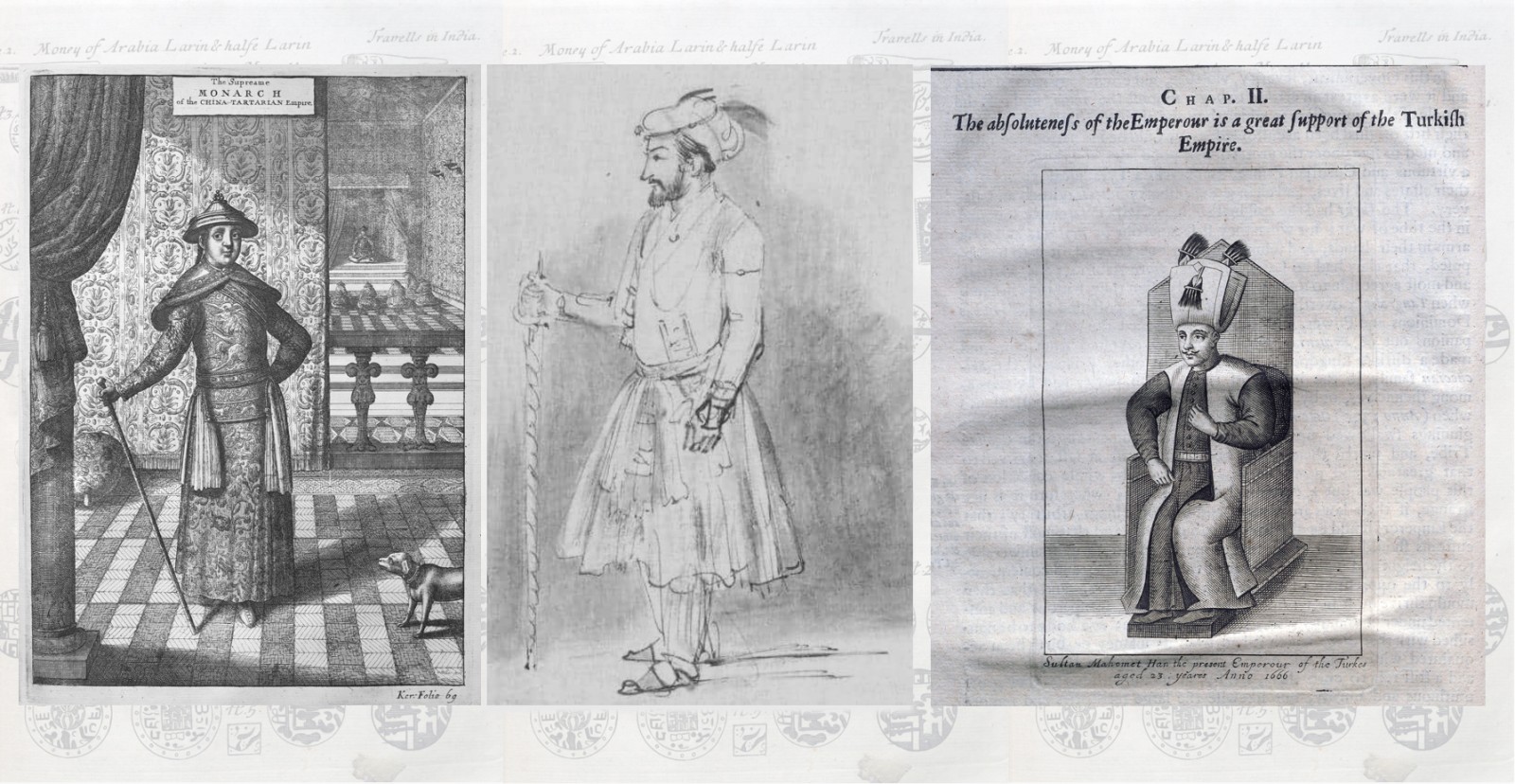
Composite image: Montanus, Arnoldus. 1671. Atlas Chinensis: Being a Second Part of a Relation of Remarkable Passages in Two Embassies from the East-India Company of the United Provinces… Translated by John Ogilby. London. | Rycaut, Paul, Richard Knolles, Robert White, Frederick Hendrick van Hove, John Macock, and John Starkey. 1680. The History of the Turkish Empire from the Year 1623 to the Year 1677… London. | Tavernier, Jean-Baptiste, and François Bernier. 1688. Collections of Travels through Turky into Persia, and the East-Indies. Giving an Account of the State of Those Countries… Translated by J. Philips and Edmund Everard. London. | Rembrandt, Two Mughal noblemen (Shah Jahan and Dara Shikoh), 1656, pen and wash on paper, The British Museum, courtesy of Wikimedia Commons. All other images courtesy of the William Andrews Clark Memorial Library, with special thanks to Arie Nair, Reading Room Assistant and Ph.D. Candidate, University of California, Los Angeles.
,_Rembrandt,_c.1656.jpg)