

Date/Time
Friday, March 6, 2026
9:00 am PST – 5:00 pm PST
Location
UCLA William Andrews Clark Memorial Library
2520 Cimarron Street

Registration Form: Core 2 Form
Organized by Choon Hwee Koh (History, UCLA), Meng Zhang (History, UCLA), and Abhishek Kaicker (History, UC Berkeley)
Co-sponsored by the UCLA Program on Central Asia, Center for Near Eastern Studies, and Center for Chinese Studies
The second conference looks at Imperial Operations. How did empires work? What did the mundane, everyday operations of imperial rule look like? Early modern empires confronted the same “great enemy” of distance which severely constrained all actions, from government communications to tax collection. The solutions that the Ottomans, Mughals, and the Qing developed to address these common problems shared some essential features despite their local variations. For imperial communications, each empire had their version of a relay postal system that relied on horses, human-runners, or a combination of both. For the problem of tax collection, each empire distributed tax farming privileges across extensive networks of local intermediaries. Scholars have suggested that empires devised comparable systems of delegating authority and distributing tasks that had more organizational sophistication than previously recognized. Given that such systems of communication and tax collection were apparently autonomously developed in each empire, it is remarkable that these institutional solutions came to acquire significant resemblances with each other. Investigations into these and other areas of imperial operations will lay the foundation for a conceptual framework that might account for both their commonalities and differences and work equally well for these different regions without presuming one type of institutional response as being a universal ideal.
Our prompt to participants of the second conference: How did administrative, tax, or legal innovation overcome the problems of imperial consolidation in the empire of your study? How did they change in this time period compared to previous eras? Is there a particular imperial operation that you have examined in this time period? (This could be a process of resource extraction, of recruiting or managing personnel, of integrating ethno-religious minorities, of instituting new laws, etc.) Is there a question you have for experts of other empires on how this same imperial operation worked there? How might that knowledge help you better understand the empire of your focus?
Speakers
Nicholas J. Abbott, Old Dominion University
Abdurrahman Atçıl, Sabancı University
Anil Askin, Ahmanson-Getty Postdoctoral Fellow
Li Chen, University of Toronto
Munis D. Faruqui, University of California, Berkeley
Evgenia Kermeli, Hacettepe University / Käte Hamburger Kolleg “Legal Unity and Pluralism” Münster
Jaymin Kim, Rice University
Sudev Sheth, University of Pennsylvania
Christopher Whitehead, The Ohio State University
Lawrence Lok Cheung Zhang, Hong Kong University of Science and Technology
About the 2025–26 Core Program: Strange Synchronicities and Familiar Parallels in Asia, 1600–1800: Joseph Fletcher’s Plane Ride Revisited
In the 1970s, polyglot Sinologist and Inner Asian specialist Joseph Fletcher had a powerful insight: there were both “interconnections” and “parallels” across the early modern world. Despite Fletcher’s untimely death in 1984, his insight of “interconnections” captured the imagination of a generation of historians who went on to craft histories that were “connected” or, even, “global.” These histories highlighted the myriad kinds of “interconnections” that had forged early modernity.
With this overwhelming attention to “connections,” Fletcher’s second notion of “parallels” came to be relatively neglected. Comparative history, with its profound methodological challenges regarding unit, scale, and criteria of comparison, came to be passed over in favor of the agenda and paradigm of “connected history.” This relative neglect of comparative history has restricted our understanding of the early modern world, in which strange synchronicities and familiar parallels appear across disparate world-regions that were yet to be violently incorporated into a modern global order centered on Europe.
In this cycle of three conferences, historians of the Ottoman, Qing, and Mughal empires return to the problem of comparison by considering synchronicities and structural parallels across Asia. We focus on three broad areas: Imperial Ideology (Empires of Thought), Imperial Operations (Empires in Practice), and Society, Materiality, and Knowledge (Empires of Things).
Early modern empires confronted many similar problems: the ideological and administrative problems of managing diversity, the informational and fiscal problems caused by distance, the centrifugal and centripetal tensions of power, and the delineation and co-optation of status groups, to name a few. The many different solutions that had developed in different regions also shared some striking similarities in their underlying logic. In jointly exploring such differences and commonalities across early modern Eurasia, we aim to devise fresh methodological approaches to tackle old comparative questions in new ways.
Program Schedule
8:30 a.m.
Coffee and Registration
9:00 a.m.
Director’s Welcome
Bronwen Wilson, University of California, Los Angeles
Introductory Remarks
Choon Hwee Koh, University of California, Los Angeles, Meng Zhang, University of California, Los Angeles, and Abhishek Kaicker, University of California, Berkeley
9:15–10:45 a.m.
Panel 1: Imperial Rule in the Locality
Discussant: R. Bin Wong, University of California, Los Angeles
Li Chen, University of Toronto
“Humanizing the Conquest Regime: Benevolent Rule and Sentimental Politics in Qing Criminal Justice, 1650–1900”
Abdurrahman Atçıl, Sabancı University
“Centralized Inclusive Lawmaking: Regulating Political Power through Provincial Law Codes in the Ottoman Empire”
Munis D. Faruqui, University of California, Berkeley
“A Year in the Life of a Mughal Province: Gujarat, 1702-3”
10:45 a.m.
Coffee Break
11 a.m.–12:30 p.m.
Panel 2: Imperial Law and Politics
Discussant: Kevan Harris, University of California, Los Angeles
Evgenia Kermeli, Hacettepe University / Käte Hamburger Kolleg “Legal Unity and Pluralism” Münster
“The Pluri-Legal Ottoman Law in Action: Jurisprudence and Judicial Praxis of Ottoman Christian Courts”
Nicholas J. Abbott, Old Dominion University
“In Her Excellency’s Sublime Service: Female Elites and Imperial Recruitment in Mughal India, c. 1550–1750”
Jaymin Kim, Rice University
“Imperial Jurisdiction over Tributary Subjects: Elastic Sovereignty in Three Qing Borderlands”
12:30 p.m.
Lunch
Exhibition of Clark Library materials in the North Book Room
1:30–2:45 p.m.
Panel 3: Merchant and Administration
Discussant: Cristóbal Amunátegui, University of California, Los Angeles
Sudev Sheth, University of Pennsylvania
“Nagarsheth, or Chief Merchant of the City: The Making of an Urban Institution in Eighteenth-Century Ahmedabad”
Anıl Aşkın, Ahmanson-Getty Postdoctoral Fellow, University of California, Los Angeles
“Economies of War and Merchant Capital in the Early Modern Ottoman Empire (1600-1800)”
2:45 p.m.
Coffee Break
3:00–4:15 p.m.
Panel 4: Finance and Power
Discussant: Luke Yarbrough, University of California, Los Angeles
Lawrence Lok Cheung Zhang, Hong Kong University of Science and Technology
“Outsourcing War: Kangxi Period office purchase and the financing of conquest”
Christopher Whitehead, The Ohio State University
“Bribery and the Sale of Office in the Seventeenth-Century Ottoman Empire”
4:15 p.m.
Roundtable Discussion
5:30 p.m.
Conclusion
The conference is free to attend with advance registration, and will be held in-person at the Clark Library. Seating is limited at the Clark Library; walk-in registrants are welcome as space permits.
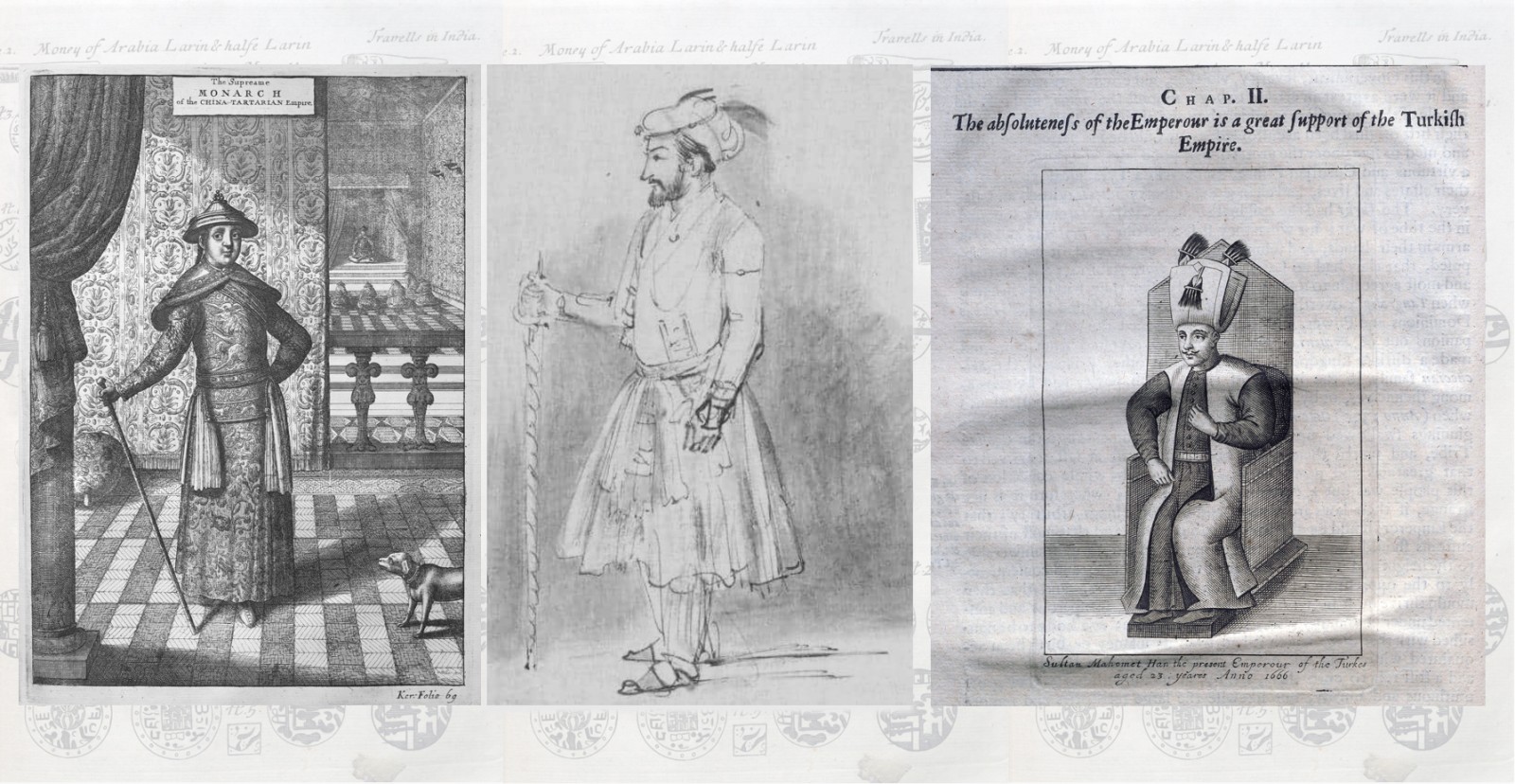
Composite image: Montanus, Arnoldus. 1671. Atlas Chinensis: Being a Second Part of a Relation of Remarkable Passages in Two Embassies from the East-India Company of the United Provinces… Translated by John Ogilby. London. | Rycaut, Paul, Richard Knolles, Robert White, Frederick Hendrick van Hove, John Macock, and John Starkey. 1680. The History of the Turkish Empire from the Year 1623 to the Year 1677… London. | Tavernier, Jean-Baptiste, and François Bernier. 1688. Collections of Travels through Turky into Persia, and the East-Indies. Giving an Account of the State of Those Countries… Translated by J. Philips and Edmund Everard. London. | Rembrandt, Two Mughal noblemen (Shah Jahan and Dara Shikoh), 1656, pen and wash on paper, The British Museum, courtesy of Wikimedia Commons. All other images courtesy of the William Andrews Clark Memorial Library, with special thanks to Arie Nair, Reading Room Assistant and Ph.D. Candidate, University of California, Los Angeles.
,_Rembrandt,_c.1656.jpg)