

Date/Time
Friday, May 8, 2026
9:00 am PDT – 5:30 pm PDT
Location
UCLA William Andrews Clark Memorial Library
2520 Cimarron Street

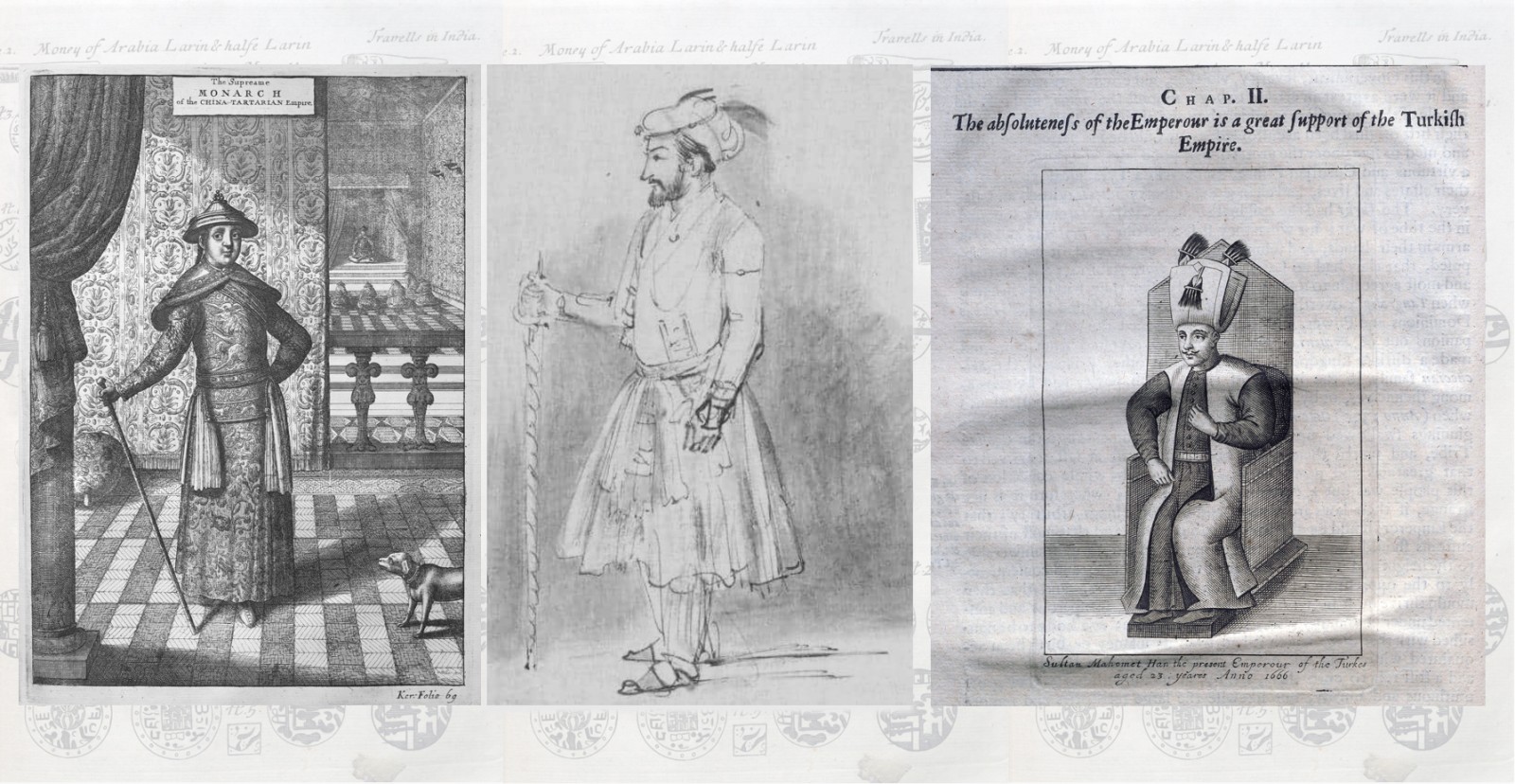
Organized by Choon Hwee Koh (History, UCLA), Meng Zhang (History, UCLA), and Abhishek Kaicker (History, UC Berkeley)
Co-sponsored by the UCLA Program on Central Asia, Center for Near Eastern Studies, and Center for Chinese Studies
The third conference looks at Society, Materiality, and Knowledge. In Fletcher’s terms, a “quickening tempo” of increased mobility and commercial activity across the early modern Eurasian space heightened imperial concerns about the effectiveness of political control over increasingly assertive and unruly subjects. Since Fletcher’s work, scholars have discerned a new momentum in cultural production driven by emerging anxieties over a changing social and economic order. These fears were reflected in literature, in legal codes that tried to reinforce status hierarchies, and in new modes of religiosity and spiritual movements. In what new ways did merchants trade, how did artisans and craftsmen organize themselves, how did guilds transform, how did the pious communicate with each other, how did common subjects live, how did spatial imaginaries change?
Whereas the first two conferences largely assume the position and spatiality of the empire, this conference follows the currents of social, material, and knowledge movements across a local, communal, oceanic, or trans-imperial space that might have propelled, supplemented, paralleled, superseded, or completely ignored the agenda of the empire. Rather than assuming a dichotomy of state and society as the norm, we are interested in exploring different modes of mutual interactions in various arenas of power.
Our prompt to participants of the third conference: What social processes or social patterns that emerged in this period had enduring consequences across space and/or time? Is there a material artifact that captures, in your analysis, a defining characteristic of the seventeenth and eighteenth centuries in the empire you study? Is there a mode of knowledge production that captures the particularity of these two centuries in the empire you study?
Speakers
Oscar Aguirre-Mandujano, University of Pennsylvania
John J. Curry, University of Nevada, Las Vegas
Devin Fitzgerald, University of California, Los Angeles
Anne Gerritsen, University of Warwick
Sourav Ghosh, Lehigh University
Farhat Hasan, University of Delhi
Jasmin Wai Tan Law, Ahmanson-Getty Postdoctoral Fellow
Sylvia Tongyan Qiu, University of California, Los Angeles
Stacey Van Vleet, University of California, Berkeley
Guanmian Xu, Peking University
About the 2025–26 Core Program: Strange Synchronicities and Familiar Parallels in Asia, 1600–1800: Joseph Fletcher’s Plane Ride Revisited
In the 1970s, polyglot Sinologist and Inner Asian specialist Joseph Fletcher had a powerful insight: there were both “interconnections” and “parallels” across the early modern world. Despite Fletcher’s untimely death in 1984, his insight of “interconnections” captured the imagination of a generation of historians who went on to craft histories that were “connected” or, even, “global.” These histories highlighted the myriad kinds of “interconnections” that had forged early modernity.
With this overwhelming attention to “connections,” Fletcher’s second notion of “parallels” came to be relatively neglected. Comparative history, with its profound methodological challenges regarding unit, scale, and criteria of comparison, came to be passed over in favor of the agenda and paradigm of “connected history.” This relative neglect of comparative history has restricted our understanding of the early modern world, in which strange synchronicities and familiar parallels appear across disparate world-regions that were yet to be violently incorporated into a modern global order centered on Europe.
In this cycle of three conferences, historians of the Ottoman, Qing, and Mughal empires return to the problem of comparison by considering synchronicities and structural parallels across Asia. We focus on three broad areas: Imperial Ideology (Empires of Thought), Imperial Operations (Empires in Practice), and Society, Materiality, and Knowledge (Empires of Things).
Early modern empires confronted many similar problems: the ideological and administrative problems of managing diversity, the informational and fiscal problems caused by distance, the centrifugal and centripetal tensions of power, and the delineation and co-optation of status groups, to name a few. The many different solutions that had developed in different regions also shared some striking similarities in their underlying logic. In jointly exploring such differences and commonalities across early modern Eurasia, we aim to devise fresh methodological approaches to tackle old comparative questions in new ways.
Program Schedule
8:30 a.m.
Coffee and Registration
9:00 a.m.
Director’s Welcome
Bronwen Wilson, University of California, Los Angeles
Introductory Remarks
Choon Hwee Koh, University of California, Los Angeles; Meng Zhang, University of California, Los Angeles; and Abhishek Kaicker, University of California, Berkeley
9:15–10:15 a.m.
Panel 1: Information and Knowledge
Discussant: Sixiang Wang, University of California, Los Angeles
Oscar Aguirre-Mandujano, University of Pennsylvania
“From Gossip to Rumor: The Changing Nature of Informal Conversation in the Ottoman Empire”
Jasmin Wai Tan Law, Ahmanson-Getty Postdoctoral Fellow
“Knowing ‘Holland’ in Seventeenth-Century Ming–Qing China”
Devin Fitzgerald, University of California, Los Angeles
“Printing Like a State: Information Management and Bureaucracy in the Early Ming”
10:15–10:45 a.m.
Coffee Break
10:45–11:30 a.m.
Panel 2: Urban Sociality and Religiosity
Discussant: Luke Yarbrough, University of California, Los Angeles
John J. Curry, University of Nevada, Las Vegas
“The Hagiography of Unsi Hasan Efendi as an Artifact of Widening Literary Production in the Eighteenth-Century Ottoman Empire”
Anne Gerritsen, University of Warwick
“The Merchant and The Temple: The Infrastructures of Jiangxi Migrants’ Commerce”
11:30 a.m.–12:30 p.m.
Roundtable Discussion I
12:30–2:00 p.m.
Lunch
Exhibition of Clark Library materials in the North Book Room
2:00–3:00 p.m.
Panel 3: Materials of Empire
Discussant: Andrea Goldman, University of California, Los Angeles
Sourav Ghosh, Lehigh University
“The Katar’s Edge: Forging Rajput Kingship in Seventeenth-Century Mughal India”
Sylvia Tongyan Qiu, University of California, Los Angeles
“Transimperial Stones: ‘Islamic Jades’ and the Politics of Gem Inlays in Early Modern Eurasia”
Guanmian Xu, Peking University
“Sugar and the Expansion of Qing Capitalism in Tropical Asia”
3:00–3:15 p.m.
Health Break
3:15–4:00 p.m.
Panel 4: Medicine and Biopolitics
Discussant: Elizabeth O’Brien, University of California, Los Angeles
Farhat Hasan, University of Delhi
“Body, Health, and Preventative Care in Early Modern South Asia: The Cosmopolis-Local Interactions and the Development of Medical Episteme, Seventeenth-Eighteenth Centuries”
Stacey Van Vleet, University of California, Berkeley
“Precious Pills, Buddhist Medical Bureaucracy, and the Biopolitics of Qing Inner Asia”
4:00–4:30 p.m.
Coffee Break
4:30–5:30 p.m.
Roundtable Discussion II
5:30 p.m.
Conclusion
The conference is free to attend with advance registration, and will be held in-person at the Clark Library. Seating is limited at the Clark Library; walk-in registrants are welcome as space permits.
Composite image: Montanus, Arnoldus. 1671. Atlas Chinensis: Being a Second Part of a Relation of Remarkable Passages in Two Embassies from the East-India Company of the United Provinces… Translated by John Ogilby. London. | Rycaut, Paul, Richard Knolles, Robert White, Frederick Hendrick van Hove, John Macock, and John Starkey. 1680. The History of the Turkish Empire from the Year 1623 to the Year 1677… London. | Tavernier, Jean-Baptiste, and François Bernier. 1688. Collections of Travels through Turky into Persia, and the East-Indies. Giving an Account of the State of Those Countries… Translated by J. Philips and Edmund Everard. London. | Rembrandt, Two Mughal noblemen (Shah Jahan and Dara Shikoh), 1656, pen and wash on paper, The British Museum, courtesy of Wikimedia Commons. All other images courtesy of the William Andrews Clark Memorial Library, with special thanks to Arie Nair, Reading Room Assistant and Ph.D. Candidate, University of California, Los Angeles.
,_Rembrandt,_c.1656.jpg)