

My dissertation, “Georgic Ecologies: Nature, Poetry, and Ideology in an Age of Improvement,” addresses changing eighteenth-century concepts of nature and critically appraises the period’s dominant ideological program of scientific “improvement.” In early eighteenth-century Britain, broadly accepted notions of “nature” as a divinely created providential order increasingly came under pressure from newer scientific, economic, and technological conceptions of humans’ relation to the nonhuman world. Under the growing influence of Baconian science and amid profitable innovations in forestry, agriculture, animal husbandry, and mining, these decades witnessed the culmination of nature’s transformation into something like its modern image: a law-bound mechanistic system, a proprietary domain of raw materials for private enterprise, and an economic externality furnishing cheap inputs and absorbing waste products.
My research demonstrates how this ascendant political ecology was self-consciously theorized and popularized in the period’s ambitious “georgic” poems, epic-length didactic works on the virtues of labor. If Virgilian georgic delineated how and according to what values humans should labor to transform the natural world, I argue that British georgics advocating “improvement”—of the land, the individual, and the nation—helped reconfigure those practices and values within new capitalist logics of commodification, extraction, productivity, and progress. Mid-century British poets repurposed elements of Epicurean materialism, Virgilian rhetoric, and Baconian experimentation in order to redefine foundational concepts like nature, value, and the common weal, uniting the idiosyncratic practical efforts of improvers and embedding them within a coherent philosophical and political narrative.
My fellowship at the Clark provided the opportunity to work among a superlative collection of rare printed works from the seventeenth and eighteenth centuries. In addition to primary texts by poets like John Philips, William Somervile, James Thomson, and Richard Jago—often available in evolving successive editions—the Clark also offered a particularly rich manuscript resource in the Ann Yerbury papers (MS.1994.002) and extensive holdings in prose works relating to many of the various thematic strands of the dissertation: the evolution of post-Baconian natural philosophy and physico-theology; the ascendance of “improvement” discourse among both major figures like Gervase Markham and anonymously authored tracts and ephemera; and perhaps most importantly for my individual dissertation chapters, the long heritage of prose treatises on more specialized subjects like hunting, mining, and plantation management.


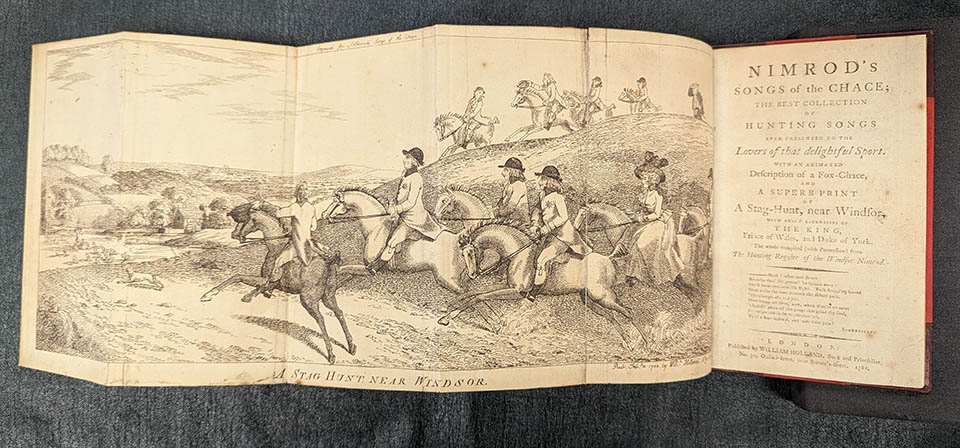
Some of the most interesting (and visually striking) texts I encountered during my fellowship period documented the history of British hunting practices and served as useful intertexts for my chapter on William Somervile’s fascinating and under-studied hunting georgic The Chace (1735). My chapter examines Somervile’s deployment of the Virgilian ethos of cura, or care, in ways that belie his fraught, often self-contradictory ambivalence between a wistful attachment to an ancien regime moral economy and a frustrated maladjustment to more modern (economistic and highly financialized) relationship to the landed estate. While care still represents the moral linchpin holding together the hierarchical relationships between king and subject, lord and renter, man and animal, Somervile’s persistent and paradoxical desire to disburden himself of the obligations of private property and submerge himself within the “natural,” ecological horizon of the hunt—to “Cast far behind the ling’ring Cares of Life”—represents an important document in animal studies and an evocative example, still several decades prior to Rousseau, of the secular affect that would come to be seen as a distinctly modern form of alienation.
I am very grateful to the Clark Library and the Kanner Foundation for the opportunity to pursue this project in such an auspicious environment. As with any such enterprise, nearly as important as the materials themselves is the vote of confidence in the project, as well as the time needed to work through the necessary leads and allow the research gradually to move beyond initial intuitions and discover its proper form.
-Christopher Catanese, Kanner Fellow 2026
 Christopher Catanese is a teaching fellow and doctoral candidate at UNC Chapel Hill who works on political ecology and eighteenth-century British poetry. His article “Refinement and Romantic Genre” was awarded the 2016 Ralph Cohen Prize and published in New Literary History, and more recent research has been supported by awards and fellowships from the Modern Language Association, UCLA’s William Andrews Clark Memorial Library, and Yale’s Beineke Library.