

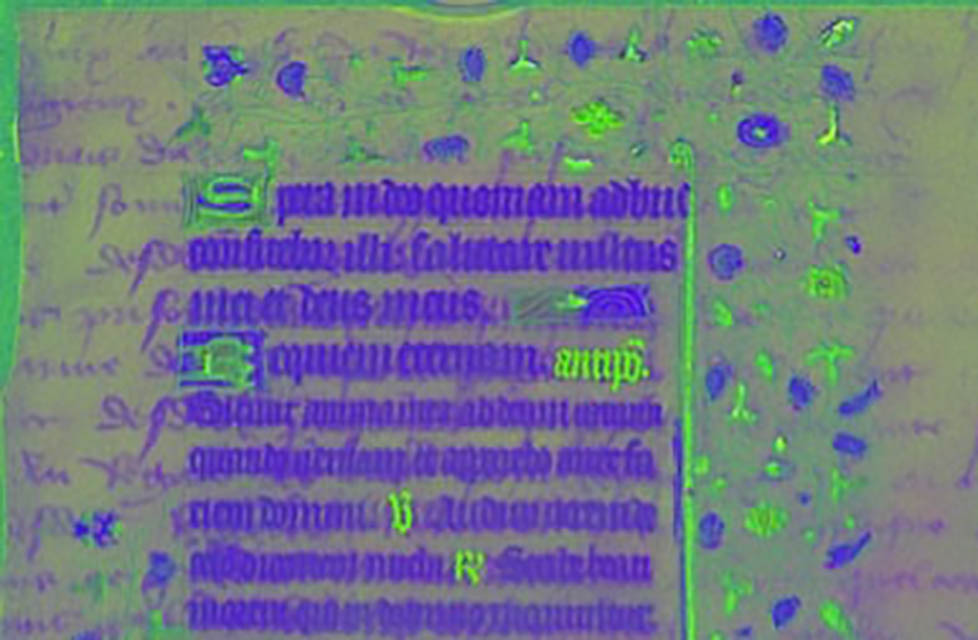
This past month I had the pleasure of attending the MISHA Summer Seminar at Rochester Institute of Technology (RIT) in Rochester, NY. MISHA stands for Multispectral Imaging for Cultural Heritage Artifacts.
This technology has the ability to image in 16 bands of light including wavelengths that are visible and some invisible to the human eye. Different wavelengths of light can reveal otherwise unreadable or invisible text. This kind of imaging is often used in conservation technical imaging, and has many applications for research in a cultural heritage environment like a library. Some of our sample data included images of Ege 30, a 15th century manuscript from the Cary Graphic Arts Collection at RIT, seen below.
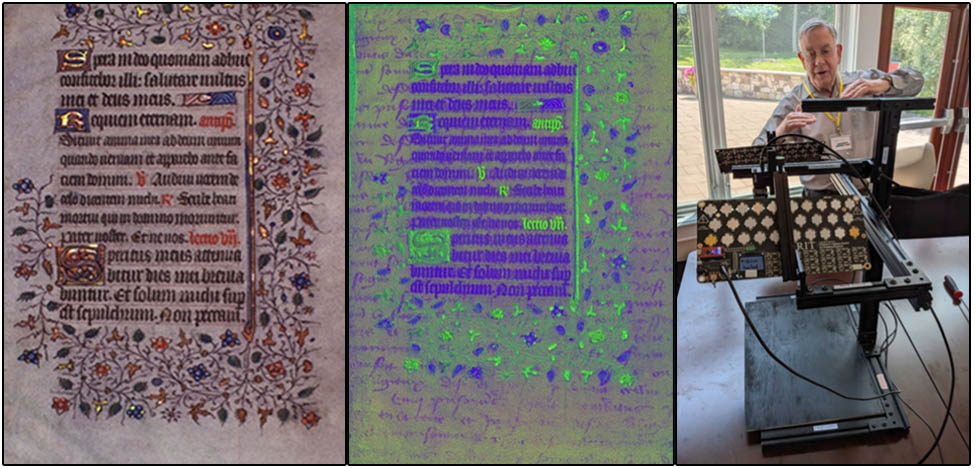
As a participant in this week-long seminar I learned to build a low-cost version of this camera system, capture images, and process them to reveal hidden materials. These kinds of images can be used for conservation and additional research and study. I am currently exploring the feasibility and use cases of adding a MISHA to the Clark Library DigiLab to support research and teaching around the science of books and manuscripts.
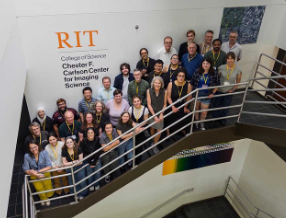 I have a unique opportunity to borrow a MISHA system to use at the Clark Library later this summer. I’m excited to test it out and investigate some of our collection materials to see what we can find. If you know of collection materials that you suspect have layered text or faded ink, please reach out and let me know.
Special thanks to the LAUC-LA Research and Professional Development Committee supporting my attendance at this seminar.
-Krystal Boehlert, Digital Collections Librarian, kboehlert@humnet.ucla.edu