

“If you picked any book from that line you would be picking a little fibre also from my mind…an intimate and essential part of what is now myself. Hereditary impulses, personal experiences, books – those are the three forces which go to the making of man.” – Arthur Conan Doyle
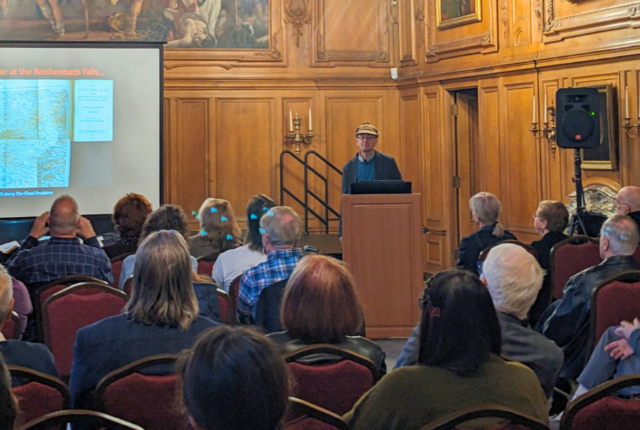
With this quote from Sir Arthur Conan Doyle’s 1907 book “Through the Magic Door,” Doyle’s reflections on literature and the power of reading (previously published in six articles entitled “Before My Bookcase” in the publication Great Thoughts from May–June 1894) serving as a guiding force, Dr. William Zachs, Director of the Blackie House Library and Museum in Edinburgh, Scotland, delivered a fascinating and entertaining lecture on Monday, November 2 at the William Andrews Clark Memorial Library.
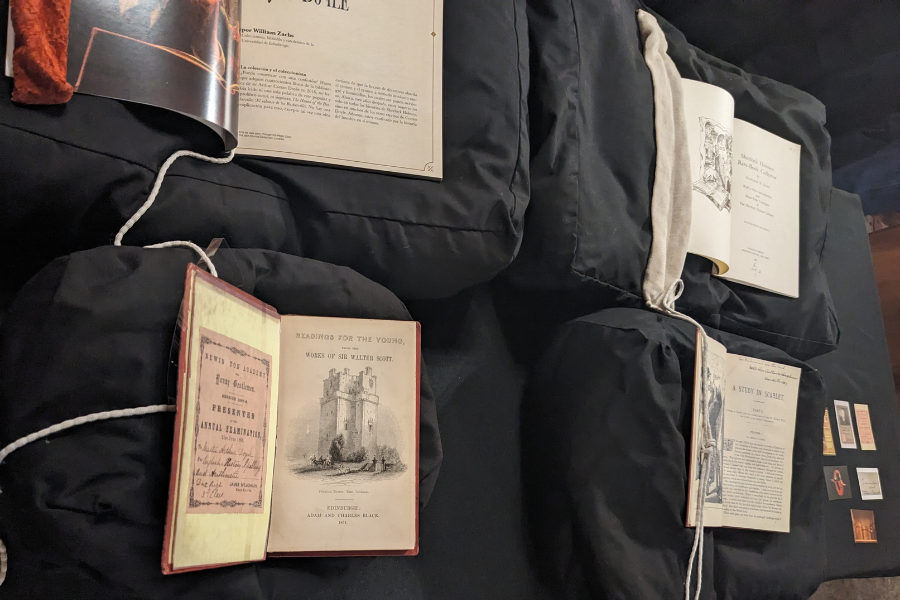
Doyle’s personal library, of which 400 volumes were acquisitioned by the Blackie House Library, was brought to vivid life by Dr. Zachs through insightful storylines and the literary history therein. Sir Doyle’s personal library held more than 5,000 books, though over the years many of the volumes have been parceled away. Dr. Zachs lecture brought audience members on a deep dive into Doyle’s remaining collection including some actual examples on display (as seen above), highlighting its rich connections to Scottish literature, the ways in which it provides critical context for the writings and concepts of Sir Doyle’s era, and the how certain volumes influenced his most famous literary creation; Sherlock Holmes.
Beginning with Sir Doyle’s time as a student at the University of Edinburgh training to become a medic, Dr. Zachs shared a quote from Doyle illuminating his early love of reading and how his “omnivorous mind” amassed such a large and multifarious collection of books. On Doyle’s way to medical classes, he passed “the most fascinating bookshop in the world. Outside the door of it stood a large tub filled with an ever-changing litter of tattered books… There was an entrancing five minutes’ digging … until one found something which made it all worthwhile.” This adventuresome outlook of Doyle as voracious reader and avid bibliophile would continue throughout his life.
Doyle’s aspirations as a writer were deeply influenced by Sir Walter Scott, of which the “Scott Monument” – a Victorian Gothic monument to the author – is visible from the windows of Blackie House. Sir Scott is credited with creating the historical novel, which Doyle aspired to, and “Readings for the Young” a collection of Sir Walter Scott’s works is considered the “first book” in Doyle’s library as it was a prize won by the author in his youth for his studies. While Doyle held literary aspirations to follow in Scott’s footsteps, his creation Sherlock Holmes continually got in the way of this through the sheer force of Holmes’ popularity with readers and subsequent publisher and financial demands.
Volumes in the Doyle collection that tease out these Sherlockian connections include “Social Chaos and the Way Out” by Alfred Baker Read, which considers biological positivism and other theories of criminality; musing on the idea of whether one is “born a criminal,” “The Poet at the Breakfast Table” by Oliver Wendell Holmes Sr. (like Sir Doyle, also a man of medicine and author), which demonstrates how “delicate thought is continually reinforced by…the analogy which shows the wide accurate knowledge behind it,” as well as “Handwriting and Expressionism” a 1892 book translated and edited by John Holt Schooling from the French graphologist Jules Crépieux-Jamin’s “L’Écriture et le caractère,” from which the examination of someone’s handwriting proposes to reveal aspects of that person’s character and (mis)behavior. Cumulatively these works and others highlight the scholarship and ideas of Doyle’s time, which directly contributed to the analytical perspective of Detective Holmes’ stories.
Throughout his lecture Dr. Zachs draws lines back to “Through the Magic Door” showing Sir Doyle’s connections to other authors of his time, for example Robert Louis Stevenson. Both Doyle and Stevenson knew the doctor Joseph Bell, said to be the real-life inspiration for Sherlock Holmes, and had corresponded with each other and studied one another’s writings. Of the many compelling details in this lecture were the the marginalia “conversation” between the two – writings in the margin of Doyle’s copy – that comment upon Stevenson’s work, including a very Holmes-ian note from Doyle: “save reason which must predominate.”
With entertaining asides and compelling details, Dr. Zachs guided the audience through multiple “magic doors” of his own, illuminating the enduring impact of Sir Arthur Conan Doyle’s work and the rich scholarship and insights we can draw from his personal library now on view and available to researchers far and wide.
To learn more about the Blackie House and Museum, or to arrange a research appointment, please visit: https://blackiehouse.org/
To watch or revisit Dr. Zachs lecture, please visit the Center’s YouTube Channel: https://www.youtube.com/live/qDq41lYY_s8?si=LuyILo7DiDpJJWVW