

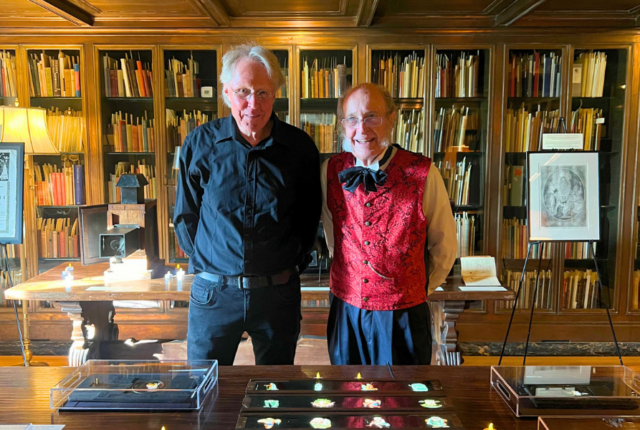
On October 28, the Clark Library welcomed Terry Borton and the American Magic Lantern Theater for a special Halloween evening of ghosts, illusions, music, and laughter. Two sold-out performances took place in the library’s historic Drawing Room, accompanied by an extraordinary display of early magic lanterns and related materials from the collection of UCLA professor Erkki Huhtamo.
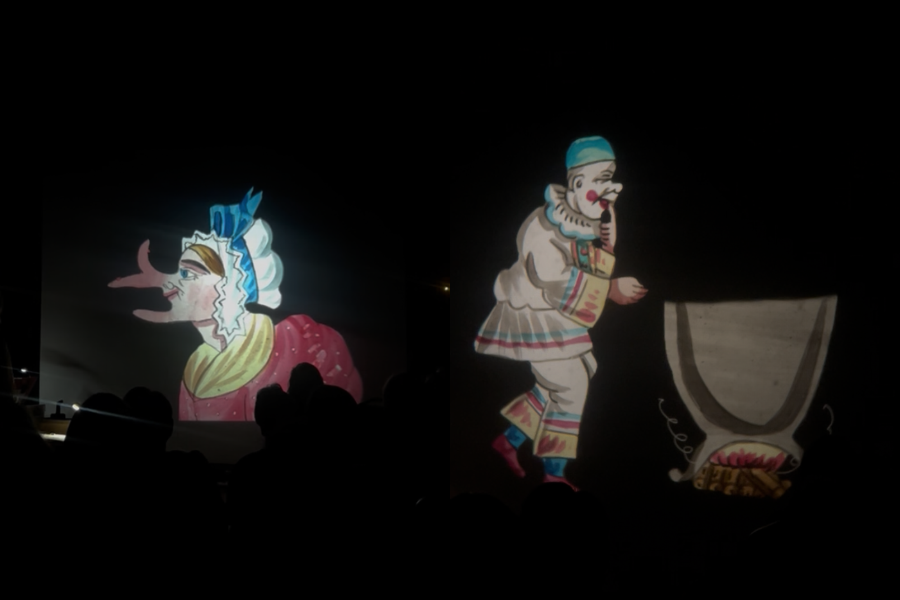
Terry Borton, a fourth-generation lanternist, and his American Magic Lantern Theater have presented more than 1,000 performances over the past 25 years, from Lincoln Center to Singapore. Terry along with pianist and soprano Elizabeth Joy Kelly presented two hour-long performances in the Clark’s Drawing Room surrounded by flickering candles. Using an original mahogany-and-brass lantern dating from the 1890s, they presented a program of Victorian stories, songs, and animated images, including Edgar Allan Poe’s The Raven, Robert Browning’s The Pied Piper, and Oliver Wendell Holmes’s The Specter Pig. The audience joined in songs, chants, and sound effects, including a particularly enthusiastic rendition of “The Worms Crawl In, the Worms Crawl Out.”
 “Bringing a magic lantern performance to the Clark had been something I wanted to do for some time, particularly around Halloween,” said Head Librarian, Derek Christian Quezada Meneses. “Having previously worked with lanternists on the exhibition Spectral Science at USC, I knew how entertaining these performances could be and how well they fit with the Clark’s collecting interests.”
The night also welcomed UCLA professor and internationally recognized media archaeologist, Erkki Huhtamo, who shared a selection of objects from his private collection. Huhtamo’s accompanying display, Phantasmagorical Treasures, explores the history of phantasmagoria, a form of magic lantern entertainment that emerged in the 1790s and used projected images of ghosts, skeletons, and other supernatural figures to astonish and sometimes terrify audiences.
Among the highlights were several exceptionally rare early nineteenth-century phantasmagoria projectors, original hand-painted slides, an eighteenth-century anamorphic skeleton that appeared upright when viewed through a cylindrical mirror, and an early animation device dating from 1834. Printed materials included a 1671 edition of Athanasius Kircher’s Ars magna lucis et umbrae, containing some of the earliest illustrations of the magic lantern, and a curious 1822 account of a soldier who claimed to have encountered a disembodied, luminous hand while escaping Napoleon’s Guard of Honor.
Huhtamo’s display provided an excellent introduction to the magic lantern performances that followed. Terry and Julia’s performances were well received by two full shows, with audiences delighted to participate in an experience familiar to audiences more than a century ago. It was truly a memorable night full of magic at the Clark Library.