

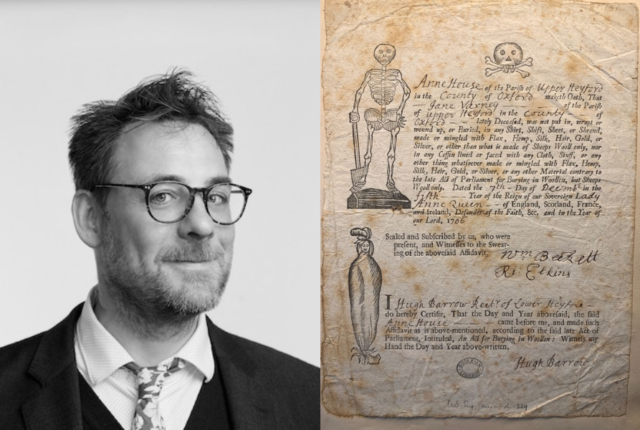
On Thursday, November 5, Dennis Duncan, Associate Professor in English at University College London, gave an absorbing and entertaining talk about the evolution of printed forms at the William Andrews Clark Memorial Library. The starting point was a group of 17th century burial forms from the village of Upper Heyford in Oxfordshire. These were produced following a series of parliamentary acts, which stipulated that the dead should be buried in shrouds made from English wool to protect the wool trade from the import of foreign textiles. Dennis showed a number of these ‘affidavits for burying in woollen’, each ‘printed for, and sold by Joseph Marshall’, who was based in Newgate Street, London. The completed forms, which include images of skulls and shrouded bodies, are a poignant reminder of hidden lives that we will never fully know and of the post-mortem administration that in our own times still accompanies periods of mourning.
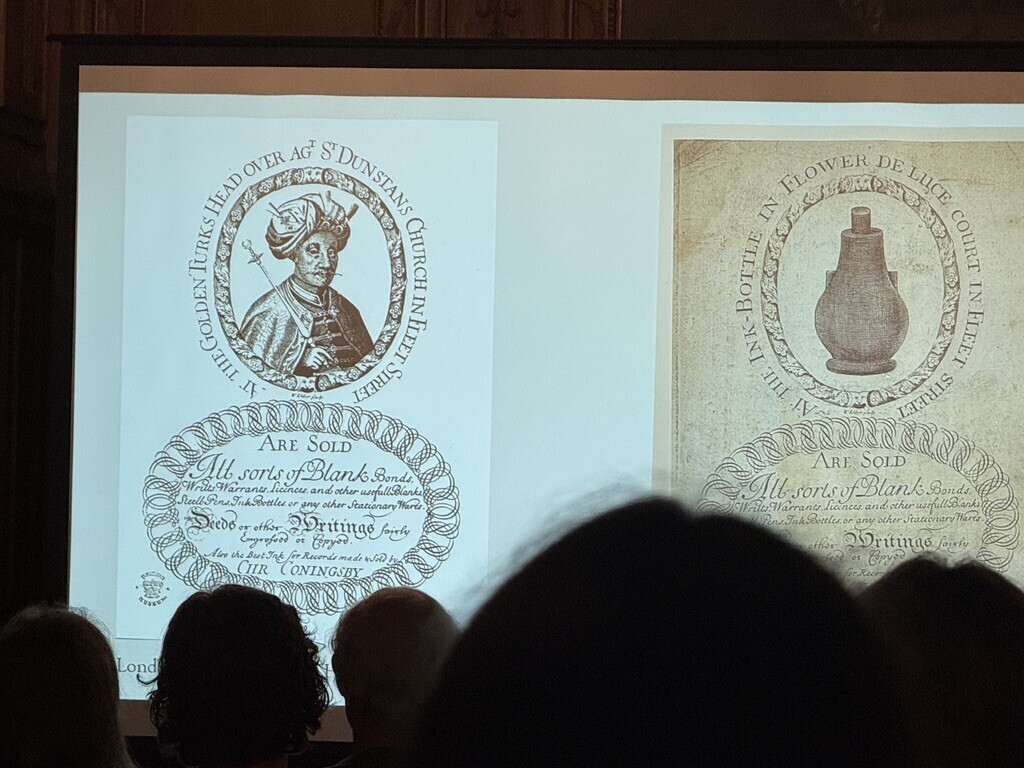
Blank forms such as the ‘affidavits’ provided an income for the book trade, as printers could be assured of a regular turnover between bigger jobs. Dennis showed fascinating catalogues produced by stationers William Farlow and John Coles, both operating in Fleet Street, London in 1750. These ‘catalogue[s] of blanks’ advertised around 100 blank forms for sale, all relating to legal and financial matters. By 1838, Shaw and Sons, operating round the corner in Fetter Lane, produced a catalogue with a mind-boggling ‘one thousand different forms of blank precedents’ for sale.
At the end of the talk, Dennis recounted a visit to the churchyard of St. Mary’s, Upper Heyford, where he found that many of the older graves had been cleared away, possibly when the church was rebuilt in the 1860s. However, he was able to find the graves of Martha and Peter Varney, likely descendants of Jane Varney, who, as the affidavits mention, had been buried in ‘Sheeps Wooll only’ in 1706. This was a highly engaging talk, which gave insight into both the print industry’s eager embrace of new bureaucratic procedures and the lives of those who purchased and completed the forms.
Before and after the talk, visitors were treated to a display of a range of related documents from the Clark collection curated by Instruction & Engagement Librarian Ikumi Crocoll.
To view the lecture, visit the Center’s YouTube channel.
-Victoria Mills, Birkbeck, University of London