

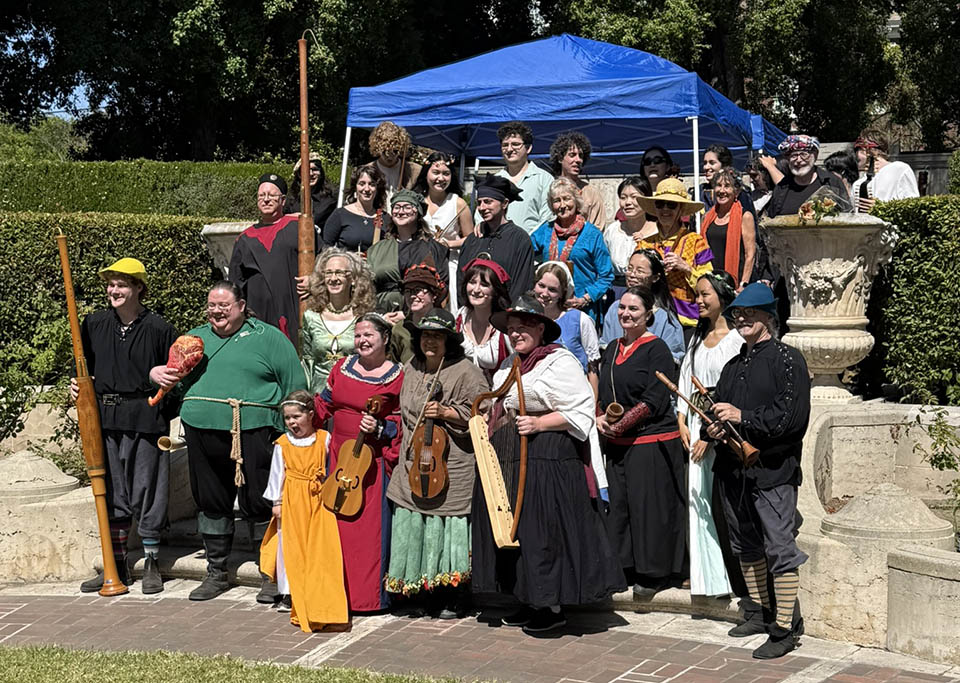
On May 31, 2026, the UCLA Early Music Ensemble, under the direction of Dr. Marylin Winkle, and joined by renowned vielle player Shira Kammen, presented a delightful performance of Adam de la Halle’s thirteenth-century pastoral play with music, Le Jeu de Robin et Marion (The Play of Robin and Marion), considered by some to be the earliest surviving tale of Robin Hood and Maid Marion.
As audience members began to gather on the lawn of the Clark Library, they were treated to a casual prelude performance of medieval and Renaissance music. A fine choice of representative genres presented an opportunity for showcasing the combined and individual talents of the ensemble players, with various pieces highlighting different instruments, including lutes, vielles, recorders, shawms, sackbuts, harps, a portative organ, and more.
Following this prelude, Dr. Elizabeth Upton (Associate Professor, UCLA Department of Musicology) presented a pre-performance lecture situating The Play of Robin et Marion in the broader history of history of the legends of Robin Hood, from medieval tales and “gestes” to modern representations in film.
 Equipped with that historical and cultural knowledge, the audience was prepared to enjoy the site-specific performance of the play itself, presented (in an English translation and adaptation by Dr. Lawrence Rosenwald, Professor Emeritus, Wellesley College) by creatively costumed actors who recited (and often sang, in truly beautiful voices) their lines, telling the comedic tale of how the shepherdess Marion, her true love Robin, and their merry friends outsmarted a knight who was determined to woo Marion and steal her away. In between scenes, the ensemble played more tunes—including dances, rounds, and songs—many of which were inspired by the Robin Hood tradition.
The combination of action and music made for a joyous and captivating experience. The players very effectively used their props and the performance area—the lawn, the walkway ramps, the trees and hedges—to transport the audience to a pastoral and forested medieval setting, and was an ideal performance for the Clark’s Arts on the Grounds series.
-Hillary Gordon, Manager, Royce Reading Room
