

Date/Time
Friday, December 4, 2026
9:00 am PST – 5:00 pm PST
Location
UCLA William Andrews Clark Memorial Library
2520 Cimarron Street

Organized by Javier Patiño Loira (University of California, Los Angeles) and David P. Bardeen (Los Angeles County Museum of Art)
This conference is part of the 2026-27 Core Program, a year-long series of three conferences – Human/Plant, Human/Animal, and Human/Machine – that invite participants from across the humanistic disciplines (including history, art history, history of science, literature, philosophy, religious history, and ecocriticism) to explore how early moderns (1400-1800) sought to define and understand themselves through their relationships with non-human life forms, entities and systems. The rise of generative models and autonomous systems has provoked intense anxieties about human exceptionalism, posing the deceptively simple question: What does it mean to be human? But “the human” has never been a stable category, particularly during the early modern period, when artists, writers and thinkers grappled with the slippery boundaries between human and non-human agencies.
The first conference, Human/Plant, considers the human relationship to the vegetal world. During the early modern period, trees and plants served as metaphors and models for thinking through human affairs, while philosophers and theologians debated the nature of the vegetative soul and the limits of plant sentience and responsiveness to the surrounding world. Furthermore, new technologies (the microscope), practices (grafting), disciplines (comparative anatomy), modes of representation (botanical drawings) and ideas (the mechanization of plant life) yielded transformative insights and new questions about plant behavior and life cycles and how they should be understood. Contributors will consider how the shifting perceptions of vegetal life challenged established hierarchies, redefined the boundaries between species—including what is intrinsically human and what is not—and informed new understandings of ecological connectedness. For purposes of the session, vegetal life is defined broadly to include agencies that have not always fit neatly within the plant/animal divide, including fungi, lichens and mosses, corals, parasites and plant-like growths, and mineral-vegetal hybrids.
Speakers
Fabrizio Baldassarri, University of Roma Tre
Natasha Heller, University of Virginia
Joela Jacobs, University of Arizona
Nicole LaBouff, Los Angeles County Museum of Art
Rong Lin, University of Illinois, Chicago
Anthony J. Meyer, NYU Institute of Fine Arts
Anca-Delia Moldovan, Howard and Roberta Ahmanson Fellow in Art and Religion, National Gallery, London
Fabien Montcher, Saint Louis University
Elizabeth Petcu, University of Edinburgh
This event is free to attend with advance registration and will be held in-person at the Clark Library. Seating is limited. Walk-in registrants are welcome as space permits. The registration form will be posted here approximately one month in advance of the program.
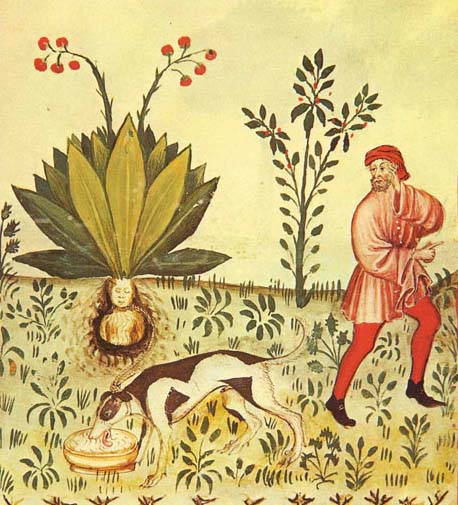
Image credit: Tacuinum sanitatis, Österreiche Nationalbibliothek, call number Cod. Ser. n. 2644, (fol. 40r).